Many towing companies in Plano now have training and equipment to safely recover electric vehicles, but you should confirm battery-handling certifications, flatbed availability, and insurance coverage before scheduling service.
The Engineering Challenges of Towing Electric Vehicles
Engineering teams equip tow rigs differently for EVs; you need awareness of high-voltage systems, battery cooling, and weight distribution to avoid damage.
Managing Excessive Curb Weight and Battery Placement
Battery placement often forces you to use low-loaders or flatbeds to prevent chassis stress; you must confirm axle ratings and secure lift points to protect cells.
Risks of Kinetic Energy Regeneration During Transport
Regeneration systems can feed energy back into the battery during towing, so you should disable regenerative braking when possible and use wheel chocks to prevent unexpected charging.
Consider that regenerative charging can create backfeed into a partially charged pack while towing downhill or if wheels rotate; you must follow OEM shutoff steps, use drive-engaged towing only when permitted, and monitor voltage to prevent thermal stress to cells.
Specialized Equipment Required for Safe EV Recovery
You should expect towing teams to carry insulated straps, EV-rated winches, isolation tools, and battery blankets so they can disconnect high-voltage systems safely while recovering your vehicle.
The Vital Role of Flatbed Trailers and Low-Clearance Decks
Flatbeds and low-clearance decks let you avoid lifting EVs by the chassis, keeping batteries and underbody components secure during transport.
Utilizing Wheel Dollies for Seized or Locked Drivetrains
Wheel dollies let you move a car with locked or seized drivetrains without spinning axles, preventing further transmission damage while you arrange transport.
Operators should size dollies for axle load and position them under unpowered wheels so you avoid stressing driveline components; you should secure each wheel to the dolly with chains or straps rated for the vehicle’s weight, confirm parking brakes are released or use dollies with integrated brakes, and verify tow crew training to minimize risk to transmission and battery systems.

Safety Protocols for High-Voltage Lithium-Ion Systems
Inspect battery areas visually and secure the scene before any tow; you should wear insulated gloves and eye protection, use nonconductive tools, isolate the high-voltage system, and coordinate with trained EV technicians to prevent shorts or inadvertent reconnection.
Identifying and Mitigating Thermal Runaway Risks
Recognize signs like swelling, persistent heat, or smoke; you should cordon off the area, keep bystanders back, cool surrounding components from a safe distance if trained, and request fire or hazmat crews for active thermal runaway to avoid escalation.
Proper Use of Manual Service Disconnects
Use the vehicle’s manual service disconnect only after confirming ignition and 12V systems are off; you should follow the manufacturer’s sequence, apply lockout/tagout, and verify absence of high-voltage with a meter before towing or handling connectors.
Verify the disconnect’s location from the owner’s manual and carry required insulated tools; you should wear PPE, avoid forcing damaged connectors, contact the manufacturer or an EV-certified technician if the enclosure is compromised, and document the disconnection and secure protective covers before transport.
Evaluating Plano Towing Infrastructure and Readiness
Plano’s towing network shows growing EV capability; you should verify local charger access, trained crews, and EV-rated equipment before choosing a provider.
Certification Standards for Local Recovery Technicians
Technicians often carry OEM or industry certifications you can request, confirming battery handling, high-voltage safety, and vehicle-specific recovery procedures.
Availability of Specialized EV Roadside Assistance
Many Plano operators offer mobile charging, EV-rated towing, and 24/7 dispatch that you can access through apps or your roadside provider.
You should confirm whether mobile chargers are Level 2 or DC fast-capable and if crews isolate high-voltage systems before recovery. Ask about flatbed availability and wheel-lift limits for specific EV models, typical response times, and proof of EV-specific training or OEM authorization.
Best Practices for Plano EV Owners During a Breakdown
When your EV stalls in Plano, stay inside if safe, move to a safe shoulder, activate hazard lights, and call a towing service skilled with EVs. Confirm they handle high-voltage vehicles and have trained technicians before dispatch.
Activating Manufacturer-Specific “Tow Mode”
Check your owner’s manual or app for the manufacturer’s “Tow Mode” procedure and engage it before towing; this protects the drivetrain and disables systems that could be damaged during transport.
Essential Information to Provide Dispatchers
Tell dispatch your EV make, model, battery state-of-charge, exact location, whether the vehicle is drivable, and if any audible warnings or leaks are present so the crew arrives prepared.
Include the vehicle identification number, current odometer reading, whether charging equipment is onboard, accessibility of tow points, and whether “Tow Mode” is active; provide a contact number and your insurance or fleet details to speed safe, compliant handling.
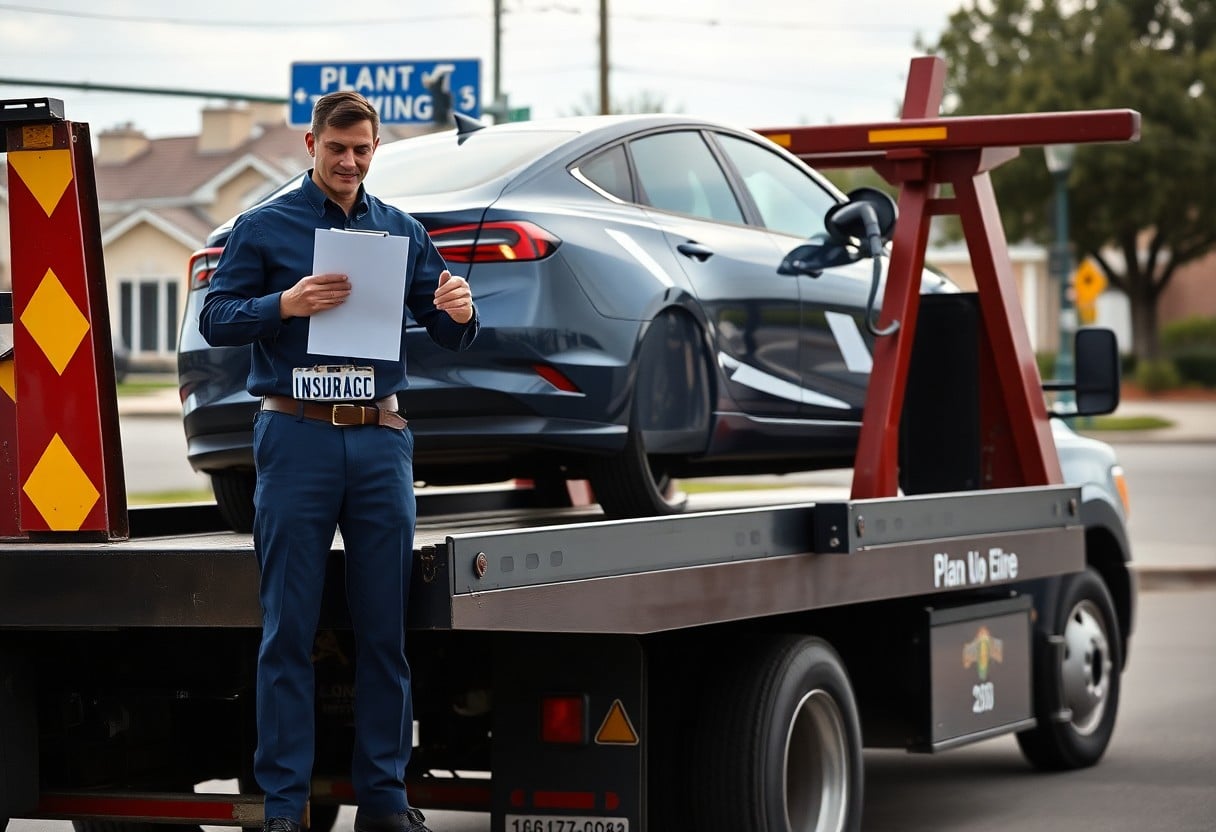
Insurance and Liability in EV Transport
Policies for EV transport often require specific endorsements; you should confirm the carrier’s insurance covers battery damage, thermal events, and recovery-related costs, and that limits match your vehicle’s replacement value.
Protecting Sensitive Underbody Components from Damage
Underbody components such as battery enclosures and coolant lines need careful handling, so you should require carriers to use flatbeds or wheel-lift techniques with soft straps and frame protection to avoid punctures or stress during loading and transit.
Verifying Carrier Coverage for High-Value Electric Assets
Verify that the carrier’s liability limits exceed your EV’s market value, that cargo and on-hook coverage explicitly include battery and high-voltage system damage, and that certificates are provided before release.
Request copies of insurance certificates, endorsements, and policy wording that name batteries and high-voltage systems; you should check limits, deductibles, sublimits for battery-related claims, the carrier’s claims contact, and whether they accept subrogation-insist on written confirmation before authorizing transport.
Final Words
The towing companies in Plano can handle most electric vehicles when you hire providers trained in EV procedures and equipped with flatbeds and insulated winches; confirm certifications, battery-safe protocols, and on-site charging options before they tow your vehicle.
FAQ
Q: Can towing companies in Plano handle electric vehicles?
A: Most towing companies in Plano can handle EVs, but capability varies by operator. Reputable companies use flatbed trucks to avoid driveline damage and employ insulated winches and EV-rated wheel restraints. Technicians trained in high-voltage safety follow manufacturer guidelines for disconnecting systems and securing the vehicle. Call ahead to confirm EV experience with your specific make and model.
Q: Do tow truck operators need special training or certification to work on EVs?
A: Many tow operators complete specialized courses on high-voltage safety and EV recovery techniques, though certification requirements differ by company. Ask whether technicians have completed OEM training or third-party EV safety programs and whether the company maintains written procedures for EV towing. Proof of training and updated insurance that covers EV-specific risks are good indicators of competence.
Q: How do towing companies protect an EV’s battery and electrical systems during transport?
A: Proper EV transport prioritizes using a flatbed or EV-compatible wheel lift to prevent drivetrain stress and battery pack damage. Tow crews follow battery isolation steps, secure the vehicle to prevent movement, and avoid winching or attaching equipment near battery enclosures. Technicians consult the vehicle manual for tow mode, towing orientation, and any state-of-charge restrictions before moving the vehicle.
Q: Will towing an electric vehicle cost more than towing a gas car in Plano?
A: Towing an EV can incur higher fees when flatbeds, specialized restraints, or trained personnel are required. Roadside assistance plans, warranties, or insurance policies may cover part or all of the added cost depending on your coverage. Request an itemized estimate that identifies any EV-specific charges before authorizing service to avoid unexpected expenses.
Q: What should EV owners do if their vehicle is immobilized on the road in Plano?
A: If stranded, provide the towing company with vehicle make, model, battery type, and current state of charge so the dispatcher can send appropriate equipment. Move to a safe location away from visible damage to battery areas and avoid attempting improvised towing without operator guidance. Keep your roadside assistance and manufacturer helpline numbers handy for options like mobile charging or OEM-recommended recovery procedures.