You will need to present your valid photo ID (driver’s license), the vehicle title or current registration, and your insurance card; if the vehicle is financed bring lienholder authorization, and if the tow follows an accident bring the police report. If you are not the registered owner bring a signed, written authorization from the owner and any tow company release forms; carrying proof of payment method and a contact phone number speeds processing.
Key Takeaways:
- Government-issued photo ID (driver’s license) to verify identity.
- Vehicle registration or vehicle title as proof of ownership.
- Proof of insurance, if available-some companies require it before release.
- Written authorization or power of attorney if you are not the vehicle owner.
- Police report for accident tows and a payment method for towing/release fees.
Understanding Towing Services
Types of Towing Services Available
You’ll encounter flatbed, wheel‑lift, dolly, heavy‑duty, and winch‑out options; flatbeds carry most passenger vehicles up to about 8,000-10,000 lbs, wheel‑lifts are common for quick local moves (often $75-$125), dollies suit short relocations, heavy‑duty rigs handle trucks and buses over 10,000 lbs, and winch‑outs recover vehicles from ditches or mud with variable fees based on complexity.
| Flatbed | Best for luxury/totaled cars; carries up to ~8,000-10,000 lbs |
| Wheel‑lift | Quick light‑duty tows; common for local moves, lower cost |
| Dolly | Short relocations for front or rear‑wheel drive vehicles |
| Heavy‑duty | Designed for trucks, buses; rated above 10,000 lbs |
| Winch‑out/Recovery | Pulls stranded vehicles from ditches, mud, or embankments |
- Mechanical breakdowns like transmission or engine failure
- Flat tires or dead batteries when you can’t change or jump-start
- Collision recovery and transport to body shops or impound lots
- Off-road or ditch recoveries requiring winch or heavy equipment
- The operator will assess vehicle weight, damage, and access before loading
Reasons for Needing Towing Services
You call towing for mechanical failures, flats, battery deaths, collisions, or when your vehicle is illegally parked or impounded; in small Texas towns average local tows run 10-15 miles and often cost $75-$125 for hookup plus $2-$4 per additional mile, so you’ll want to know which service type fits your situation.
For example, if your alternator dies on US‑75 at night, a wheel‑lift tow can get you to the nearest shop within 10-12 miles quickly; after a multi‑vehicle crash you may need a flatbed for safe transport and a police release before movers will take the car, and recovery from soft shoulders can add $100-$300 depending on extraction difficulty and required equipment.
Required Documentation for Towing
You should bring government ID, the vehicle registration or title, proof of insurance, and any written authorization if you aren’t the registered owner. Police reports are often required for accident tows, and lenders’ contact info is needed if the vehicle is financed. Tow operators will verify VIN and plate numbers, and may require a signed release form before moving or releasing the car.
Vehicle Registration
You need the registration showing the plate number and VIN, either the original or a clear photocopy or digital image. If the vehicle is leased or owned by a company, bring the lease agreement or a company authorization letter. Expired registration can slow release, and mismatched names require a notarized authorization or the title to prove ownership.
Proof of Insurance
You must present proof of liability coverage-Texas minimums are typically 30/60/25-via an insurance card, digital policy page, or binder showing policy number and effective dates. Insurers often provide written authorization for claims-related releases; without coverage you may be asked to pay towing and storage fees upfront or post a bond to obtain the vehicle.
Provide your insurer’s contact and a claim number to speed release; a declaration page or agent email works as proof while a full claim is processed. Out-of-state policies are usually accepted if they show valid coverage. In many cases insurers authorize payment to the tow company within 24-72 hours, and if a lienholder is involved the insurer may coordinate directly to satisfy storage or salvage hold requirements.
Identification Requirements
You’ll need a government‑issued photo ID that matches the vehicle registration or title; tow operators in Anna, TX typically verify name, address, and signature before releasing a car. In many cases law enforcement officers or lot supervisors will accept a Texas driver’s license, passport, or military ID. If the vehicle is registered to a business or third party, bring written authorization and a second ID to avoid delays.
Driver’s License
If you have a valid Texas driver’s license, bring the physical card; tow yards typically require it and may reject smartphone‑only IDs. Out‑of‑state licenses are usually accepted but bring the vehicle registration that matches your name. If your license is expired or suspended, expect additional verification-some yards will require proof of ownership plus a notarized release before they’ll release the vehicle. A current, unexpired license speeds processing and reduces hold time.
Additional ID Options
If you lack a driver’s license, present a state ID, passport, or military ID; many operators accept two forms of non‑photo ID plus a utility bill (dated within 30 days) as proof of address. For leased or financed vehicles, bring the lease agreement or lienholder contact information. Digital copies may be accepted by some companies, but call ahead to confirm acceptable formats.
If you send someone else to retrieve the vehicle, provide a signed, notarized authorization letter naming that person, the VIN, pick‑up date, and a photocopy of the registered owner’s ID; tow operators often call the owner to verify. If your vehicle is registered to a business, bring company letterhead, the authorized representative’s ID, and the company’s registration or EIN to establish authority quickly.

Special Circumstances
When impounds, repossessions, salvage titles, or out-of-state vehicles are involved, you’ll need extra paperwork such as lien release forms, repossession orders, salvage certificates, or a power of attorney. If the vehicle was in an accident, provide the police report number and authorized claimant name for release. Fees and hold periods can differ-impounds may impose 24-72 hour administrative holds-so bring both ID and any case or reference numbers to speed the process.
Towing for Commercial Vehicles
For commercial tows you must present company authorization on letterhead, the vehicle’s registration, the driver’s CDL, and carrier identifiers like USDOT or MC numbers for interstate carriers. Heavy-duty tows are required for vehicles with GVWR over 10,000 lbs-semis, box trucks, and buses-often needing rotators or wreckers. Expect higher hookup and mileage rates and provide a bill of lading or proof of cargo authority if freight is on board.
Towing Under Emergency Situations
When police, fire, or emergency crews order a tow after an accident or hazard, you’ll typically need the incident or case number, your ID, and insurance info to reclaim the vehicle. Emergency towing is often available 24/7 in Anna; giving the dispatcher a cross street or GPS coordinates speeds response. Sometimes municipal agencies authorize removal immediately if the vehicle blocks traffic or poses a safety risk.
After an emergency tow, obtain the tower’s invoice, impound location, and the agency authorization reference; these let you verify charges and vehicle status. If you dispute the tow or fees, contact Anna Police Department or Collin County authorities for the official report and appeals process, and keep photos or witness statements to support your case.
Local Regulations in Anna, TX
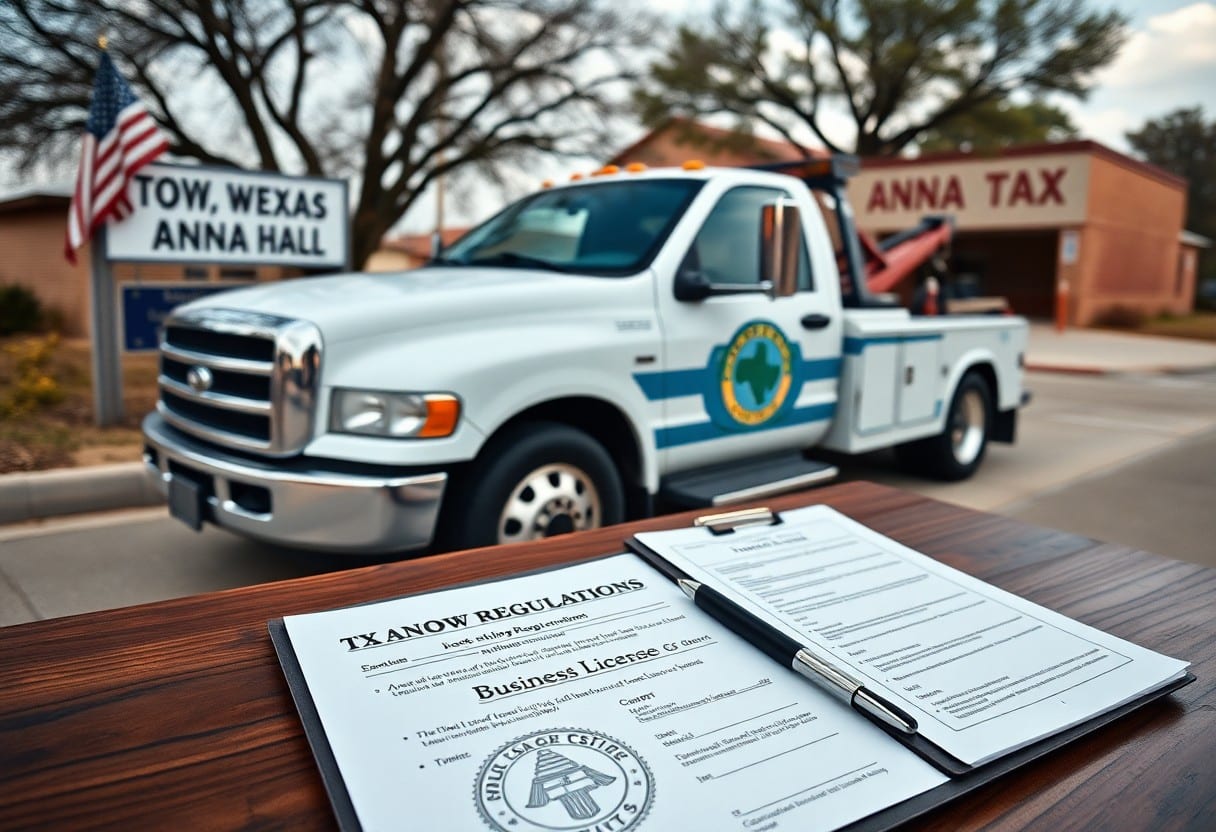
In Anna, local rules affect how you reclaim an impounded vehicle: the city requires tow operators to be permitted, post clear “No Parking/Tow Away” signage at private lots, and coordinate with Anna Police for police-ordered tows. You should expect posted hook fees (commonly around $125-$175) and daily storage charges that begin the day after impound.
City Regulations on Towing
City regulations require tow companies doing business in Anna to hold a city business permit, maintain liability insurance, and display company name and contact on trucks and invoices; you can verify a provider’s permit with Anna City Hall and should confirm their lot address and hours before authorizing release to avoid disputes over location or after-hours retrieval fees.
Compliance with State Laws
State law sets licensing, lien and consumer-protection rules you must use to challenge improper tows: you have the right to an itemized receipt, prompt vehicle release on presentation of ID and title, and channels to dispute unlawful fees or procedures through state or local consumer offices if statutory requirements aren’t met.
For additional detail, the state typically requires written notice before a tow company may sell an unclaimed vehicle and allows lien sales after statutory notice periods; in practice you’ll encounter administrative fees of $25-$100 plus daily storage rates of $10-$35, and successful disputes often hinge on documented proof that the tow lacked authorization or that required signage was not posted.
Preparing for the Towing Process
Before the tow arrives, organize your paperwork and vehicle to avoid delays: have your government ID, registration or title, and insurance card ready, unlock the car if possible, and remove loose items. Allow 15-30 minutes for the operator to arrive in urban areas and factor in possible hookup fees (commonly $75-$150) plus per‑mile charges. Take photos of the vehicle’s condition and plate to document any preexisting damage.
Key Documents to Keep Handy
Keep your driver’s license, vehicle registration or title, and current proof of insurance within reach, plus any written authorization if you aren’t the owner. Carry roadside assistance membership details (membership number and phone), a copy of lien or loan payoff info if applicable, and a photo of the VIN and license plate on your phone to speed identity and ownership verification.
Steps to Take Before Calling a Tow
Assess safety first: move to a secure spot off the roadway, turn on hazards, and set cones or warning triangles if available. Check whether a simple fix will work (jump‑start, spare tire, unlocked doors) and note exact location (GPS coordinates or nearest cross streets), vehicle make/model/color, and whether it’s drivable to relay to the tow dispatcher.
When you call, provide clear details: vehicle year, make, model, color, plate, VIN, exact location (lane, landmark, cross streets), and whether keys are inside or the vehicle is locked. State if the car is parked on private property or blocking traffic, and give your preferred destination and contact number. If you have roadside coverage, give the carrier and membership number; expect arrival times of roughly 15-45 minutes in suburban Anna depending on traffic and time of day.
Final Words
The documents you should have for towing services in Anna, TX are your vehicle registration, a valid driver’s license, and proof of insurance; if you’re not the owner bring a signed authorization or power of attorney and the owner’s ID, and if the vehicle is financed provide lienholder information or the title, plus any tow company release forms and payment method.
FAQ
Q: What identification and ownership documents are required to pick up a towed vehicle in Anna, TX?
A: To reclaim a towed vehicle you typically must present a government-issued photo ID (Texas driver’s license or passport), the vehicle’s current registration or title, and proof of insurance. The tow company will also require payment for towing and storage fees and a signed release form. If the vehicle was impounded by law enforcement, bring the police report number or impound release paperwork from the arresting agency.
Q: What do I need if I am not the vehicle owner but need to retrieve the vehicle?
A: If you are not the registered owner, bring a notarized letter of authorization signed by the owner, a photocopy of the owner’s photo ID, your own photo ID, and a copy of the vehicle’s registration or title. A power of attorney or formal written consent from the lienholder/owner may be required for some tow yards; the tow operator may also require the owner to be present for law-enforcement impounds.
Q: Which documents are required after an accident when police arranged the tow?
A: After a police-ordered tow bring your photo ID, vehicle registration, proof of insurance, and the police report number or impound release issued by the agency that authorized the tow. The impound lot may require the owner’s signature on a release and payment of all towing and storage charges before releasing the vehicle.
Q: What paperwork is needed for leased or financed vehicles?
A: For leased or financed vehicles bring the lease agreement or financing contract, contact information for the lienholder, and written authorization from the lessor or lender if they must approve vehicle release. A copy of the title (if available), the lease account number, and photo ID for the person retrieving the vehicle are commonly requested.
Q: What documents should commercial drivers or fleet managers provide for towing and retrieval of commercial vehicles?
A: Commercial vehicles generally require the driver’s CDL and photo ID, the vehicle’s registration, US DOT or MC numbers if applicable, proof of commercial liability or physical damage insurance, and a company letter on official letterhead authorizing release. Bills of lading, proof of cargo ownership, or hazardous-materials paperwork may be required before a tow yard will release a loaded or specialized commercial vehicle.