Many factors determine how quickly a tow truck reaches you in Anna, TX – typical response ranges from 15 to 45 minutes in town, longer for rural areas or during peak traffic and bad weather; when you call, give your exact location, vehicle type and any hazards so dispatch can assign the closest truck, and expect longer waits for light-duty versus heavy-duty tows or non-emergency requests.
Key Takeaways:
- Typical arrival time in Anna, TX: about 15-30 minutes for local tow companies under normal conditions within city limits.
- Peak times, severe weather, and high call volumes can extend waits to 30-60 minutes.
- Long-distance tows, heavy-vehicle recovery, or incidents on highways and remote roads often take 60+ minutes.
- Roadside assistance memberships or pre-arranged service usually get faster priority and shorter ETAs.
- Call multiple local companies, give precise location and vehicle details, and ask dispatch for an ETA to set expectations.
Factors Influencing Tow Truck Response Time
You’ll notice response times hinge on measurable variables: proximity of the operator, time of day, road type, weather, required equipment, and current dispatch load. Short hauls under 5 miles often arrive within 8-12 minutes, while runs of 15-25 miles can take 25-45 minutes or longer when compounded by heavy traffic or special events. These concrete ranges help you set expectations while waiting.
- Distance – how many miles separate you from the nearest operator; each 10 miles typically adds 12-20 minutes.
- Time of day – morning and evening rush hours often double travel time on US‑75 and SH‑5.
- Weather – rain, ice, or high winds can add 10-30 minutes and may require slower speeds.
- Vehicle type – heavy-duty or oversized loads need specialized rigs that might be 20-60 minutes farther away.
- Dispatch load – a busy weekend night or multiple simultaneous calls increases your wait as companies prioritize safety and severity.
- Road access – gated communities, unpaved shoulders, or blocked exits can force longer routing and extra hookup time.
- Perceiving unclear directions, poorly marked landmarks, or unsafe shoulders can add 15-30 minutes to arrival.
Distance from Tow Truck Operator
If the tow operator is based within 5 miles of your location you can often expect arrival in 8-12 minutes; at 10-15 miles that commonly becomes 20-35 minutes. You should account for operator dispatch zones – many Anna-area companies cover a 20-30 mile radius, so a tow from McKinney or Frisco may average 25-45 minutes depending on route and road speed limits.
Traffic Conditions
During weekday rush (roughly 6:30-9:00 AM and 4:00-6:30 PM) a 10‑mile tow can take 25-50 minutes instead of the 12-20 minutes off‑peak, especially on US‑75 corridors. You’ll see delays from school traffic, accidents, and lane reductions that directly multiply travel time and can change ETAs quickly.
When an accident or construction closes lanes, your ETA can spike by 30-60 minutes; tow operators actively monitor traffic feeds and will reroute, but detours themselves add time. You can expect longer waits during special events or severe storms-providers often stage rigs farther away during those times-so keep your dispatcher informed of exact location details and any changes to help them find the fastest available crew.
Average Tow Truck Arrival Times in Anna, TX
Typical tow truck arrival in Anna generally falls between 15-30 minutes when a local operator is nearby; you can expect 30-45 minutes if drivers are dispatched from McKinney or Denton. During morning and evening rush hours, times often extend to 40-60 minutes because of traffic. For straightforward light-duty tows many companies quote 20-minute averages, while heavy recoveries or winch jobs add 15-30 minutes to your ETA.
Daytime vs. Nighttime Response
Daytime calls usually get you a faster response-often 15-25 minutes-since more drivers are working and routes are active; if you call in peak commute periods expect 25-40 minutes due to congestion. Nighttime responses can be slower, commonly 30-60 minutes after midnight when fewer crews are on duty and safety checks slow deployments, so your wait depends on crew staffing and whether a truck is already in your immediate area.
Weekend and Holiday Considerations
Weekends and holidays typically push your wait longer because many tow companies run reduced crews; typical waits rise to 30-90 minutes on Saturdays, Sundays, and observed holidays. If you call during a major holiday like July 4th, your ETA often hinges on whether a driver is already nearby or coming off another job, and shared-call dispatching can add 15-30 minutes to your arrival time.
On major holidays such as Thanksgiving or New Year’s Eve you may face both longer waits and higher fees; some operators report 20-50% rate increases and ETAs of 45-120 minutes when roads are busy. If you have roadside coverage through your insurer or a membership service, your call may be prioritized and reduce wait times by 10-30 minutes because affiliated providers dispatch their own trucks first.
Types of Tow Services Available
You’ll encounter service types that match specific incidents: emergency rotators for heavy recoveries, flatbeds for transport-sensitive vehicles, winch recoveries for off-road incidents, local short-haul towing, and long-distance carriers for relocations. Expect emergency crews to target 15-30 minute arrivals while scheduled moves often use appointment windows. Provide your exact GPS pin, vehicle color, and license plate to speed dispatch.
- Emergency towing – rapid response for collisions or disabled vehicles on highways.
- Flatbed transport – preferred for motorcycles, luxury cars, and damage-free moves.
- Winch/recovery – suited to ditches, rollover recoveries, and stuck vehicles off-road.
- Local and long-distance hauling – local runs usually finish within 10-50 miles; long hauls are scheduled.
- Assume that traffic, weather, and time of day can add 10-40 minutes to estimated arrival.
| Emergency Towing | 15-30 minutes (30-45 in peak conditions) |
| Flatbed Transport | 20-60 minutes local; scheduled for long-distance |
| Motorcycle Towing | 20-40 minutes (specialized securement) |
| Winch/Recovery | 30-60 minutes depending on terrain |
| Long-Distance Transport | 1-3 hours to begin transit; pickup windows vary |
Emergency Towing
When you call for emergency towing on US-75 or I-35, crews prioritize safety and lane clearance and typically aim to reach you in 15-30 minutes during normal conditions; expect 30-45 minutes during storms or rush hour. Tow operators bring airbags, heavy winches, and rotators for large recoveries, and they coordinate with law enforcement for scene control. You should give concise location details and note any injuries to speed response.
Non-Emergency Towing
For scheduled moves like dealer deliveries, private transports, or repairs you can book non-emergency towing with windows from next-hour up to 24 hours; local tows within 10 miles often fall into the lower end. Rates are typically lower than emergency calls because dispatch is planned, and you can compare quotes. You should confirm vehicle height, weight, and access constraints when booking.
In Anna, a typical local non-emergency tow (under 10 miles) often runs $75-$150; flatbed specialty tows may start at $100 plus $2.50-$3.50 per mile for longer hauls. If you schedule dealer transport or multi-vehicle moves, request a written estimate, ETA window, and ask whether storage or company permits affect pickup times; providing keys and clear pickup instructions reduces delays.
How to Improve Your Chances of Quick Service
Focus on three actions that consistently shave minutes off response time: provide an exact location, relay clear vehicle and hazard details, and request the appropriate tow type. For example, sending a Google Maps pin or stating a mile marker plus lane (e.g., US‑75 northbound, MM 45, right shoulder) often reduces wait by 5-10 minutes. Move your vehicle off the travel lane if safe, keep hazard lights on, and have your membership, plate number, and vehicle year ready to speed dispatch.
Providing Accurate Location Information
Send a live location pin from your phone or state nearest cross-streets, mile marker, travel direction, and which lane you’re in; include landmarks when visibility is poor. Saying “US‑75 NB at MM 45, right shoulder by FM 455” is far faster than “near Anna.” If on a frontage road, note the house numbers or business names and whether you’re parked on the pavement or a grassy shoulder so the driver finds you immediately.
Communicating Clearly with the Dispatcher
Speak calmly, use short factual sentences, and give your vehicle make/model/year, license plate, number of occupants, whether the vehicle is drivable, and any injuries. State if you need a flatbed, wheel-lift, or heavy-duty unit and provide membership or insurance policy numbers and your preferred payment method. Ask the dispatcher for the truck type en route and an estimated arrival window so you can take appropriate safety steps while waiting.
You can use a quick script to avoid back-and-forth: “2016 Honda Accord, black, plate TX ABC123, stuck on US‑75 NB shoulder at MM 45 near FM 455; one adult, no injuries; car starts but won’t shift into drive; need flatbed; AAA member #12345.” That clarity helps the dispatcher assign a properly equipped truck and routes it efficiently, often cutting response time by several minutes.
Common Myths About Tow Truck Response Times
Marketing messages often promise uniform quick arrivals, but you should expect wide variability: in Anna, arrival windows commonly span 10-90 minutes depending on how close the operator is, whether it’s rush hour, and the service required. Emergency rotators or heavy recoveries can double typical times, while local yard proximity (within 5-10 miles) often trims waits to 15-30 minutes, so verify location and equipment before assuming a fast pickup.
“All Tow Trucks Arrive in 30 Minutes”
You’ll see 30‑minute guarantees, yet averages shift dramatically: when an operator is within 5-10 miles you’ll often wait 15-30 minutes; during peak commute times, severe weather, or multi‑vehicle pileups that same call can take 45-90 minutes. Heavy‑duty jobs, winch‑outs, and flatbed loading add 10-30 minutes each, so ask dispatch for a live ETA rather than relying on blanket promises.
“All Areas are Equally Accessible”
You might assume every road is reached the same way, but highway incidents on US‑75 clear faster than vehicles stuck on remote county or ranch roads. Narrow subdivision streets, gated communities, low‑clearance bridges, and unpaved lanes can force smaller rigs or specialized equipment, adding 20-60 minutes. Provide exact cross streets, gate codes, and surface conditions to speed routing and the right truck selection.
If you’re off a steep driveway or beyond a seasonal road closure, large wreckers may be prohibited and a lighter truck plus manpower becomes necessary, increasing both time and cost. Bridge weight limits, local ordinances, and service area boundaries in Collin County can require transfers between carriers; when you’re 15-30 miles from a dispatch yard expect 30-90 minute waits and the possibility of stepped responses.
What to Do While Waiting for a Tow Truck
While you wait, prioritize actions that keep you safe and cut response time: turn on hazard lights, move well off the roadway if possible, set the parking brake, and lock the doors while keeping your phone and keys accessible. If your vehicle blocks traffic, stay inside with seatbelt fastened and children secured; if you must exit, step at least 10 feet away from moving traffic and stand behind a barrier when available.
Safety Precautions
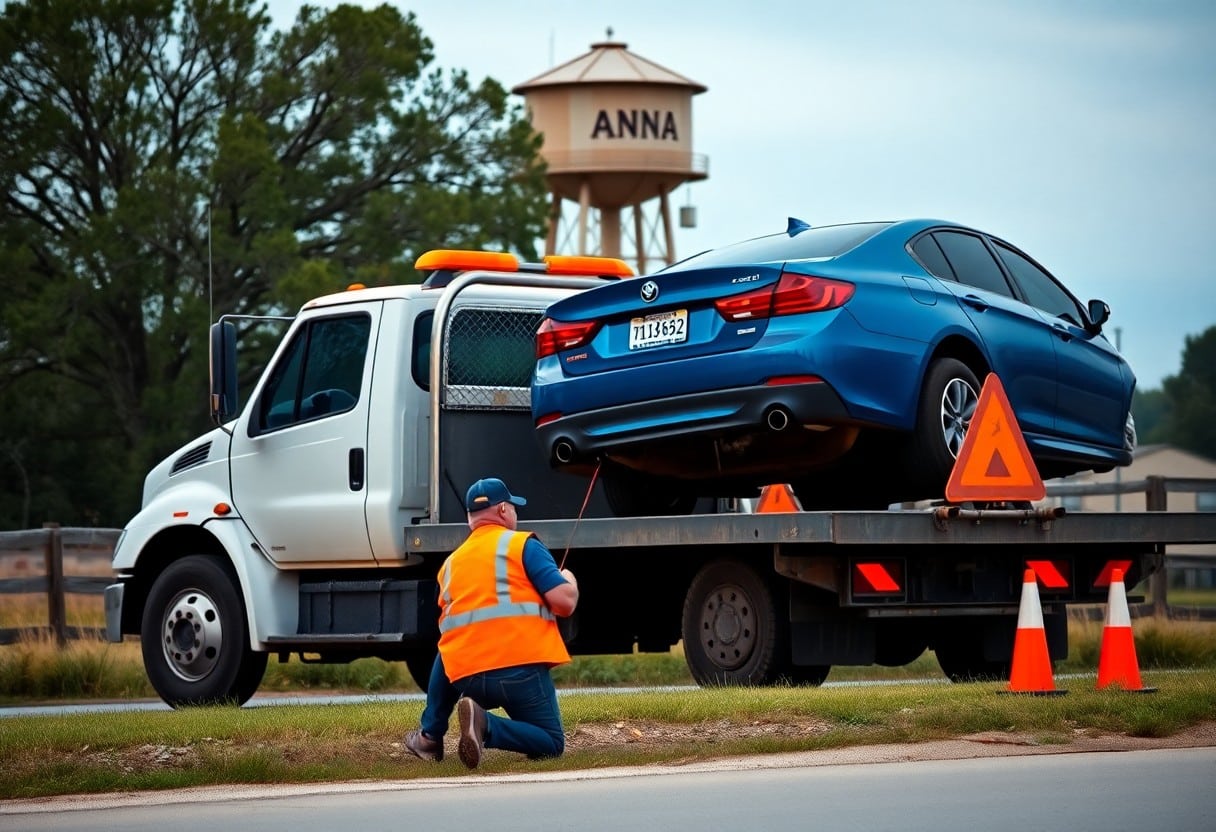
Activate hazards and place reflective triangles if you have them, ideally one about 10 feet and another around 100 feet behind your vehicle on rural roads. Turn off the engine to avoid fire risk, keep children and pets inside, and avoid standing between your car and traffic. Call 911 immediately for injuries or if a disabled vehicle creates a high-speed hazard.
Staying in Communication
Contact the tow dispatcher, give exact GPS coordinates or the nearest cross street, and describe your vehicle (make, model, color, plate). Ask for an ETA and the truck unit or driver name; typical local ETAs run 15-30 minutes but can vary. Keep your phone charged and available for the driver to call or text updates.
Use live location sharing (Google Maps or Apple Maps) to send a pin, and text photos showing damage or lane position so the driver can bring proper equipment. If you’re quoted 20 minutes and nothing arrives after 25-30 minutes, call back, confirm the unit number, and request an updated ETA or reassignment; many companies also offer SMS tracking links showing the driver’s progress.
To wrap up
Following this, you can expect a tow truck in Anna, TX to arrive typically within 20-45 minutes for most city and highway calls, though times can stretch longer during peak hours, bad weather, or in more rural spots. If you give your exact location, vehicle details, and your roadside assistance provider information, you’ll help dispatch get your truck there faster.
FAQ
Q: How long does it typically take for a tow truck to arrive in Anna, TX?
A: Typical arrival times vary by provider and situation. For local tow companies serving Anna, expect roughly 15-45 minutes under normal conditions. If a truck must come from McKinney or the wider Dallas area, allow 30-90 minutes. Factors such as rush-hour traffic, severe weather, major incidents, or holiday demand commonly extend those estimates.
Q: What factors most affect a tow truck’s arrival time?
A: The main factors are distance to the nearest available truck, current traffic and road conditions, the time of day and call volume, the type of tow required (flatbed, heavy-duty, wheel-lift), weather, whether the vehicle is in a hard-to-reach spot, and dispatch efficiency. Police or emergency scenes can also delay access and arrival.
Q: What should I tell dispatch to get the most accurate ETA?
A: Provide your exact location (GPS coordinates, mile marker, or nearest cross streets and landmarks), vehicle make/model and color, a short description of the problem (disabled, accident, flat tire, locked out), whether the vehicle is blocking traffic, need for a flatbed or heavy-duty unit, any membership provider you belong to, and a callback number. Ask the dispatcher for a confirmation number, the estimated arrival time, and the driver’s name or truck ID; request tracking or text updates if available.
Q: Are there ways I can reduce the wait time?
A: Yes. Call local Anna towing companies directly rather than distant dispatch centers, give a precise meeting point, move your vehicle to a safe, accessible spot if possible, call your roadside assistance membership (they may prioritize members), specify the exact tow type required so the correct truck is dispatched, and be ready to meet the driver and pay promptly. Using apps or services that show driver location can also shorten perceived wait time and improve communication.
Q: What can I do if a tow truck is significantly late or never arrives?
A: First call the dispatcher for an updated ETA, truck ID, and driver name. If the response is unsatisfactory, contact an alternate local towing company or your roadside assistance provider to arrange a replacement. If you are in immediate danger on a roadway, call local law enforcement or Highway Patrol. Keep a record of call times, dispatcher names, and any receipts; if service was prepaid or misrepresented, request a refund and consider filing a complaint with the Texas Department of Licensing and Regulation or the Better Business Bureau.