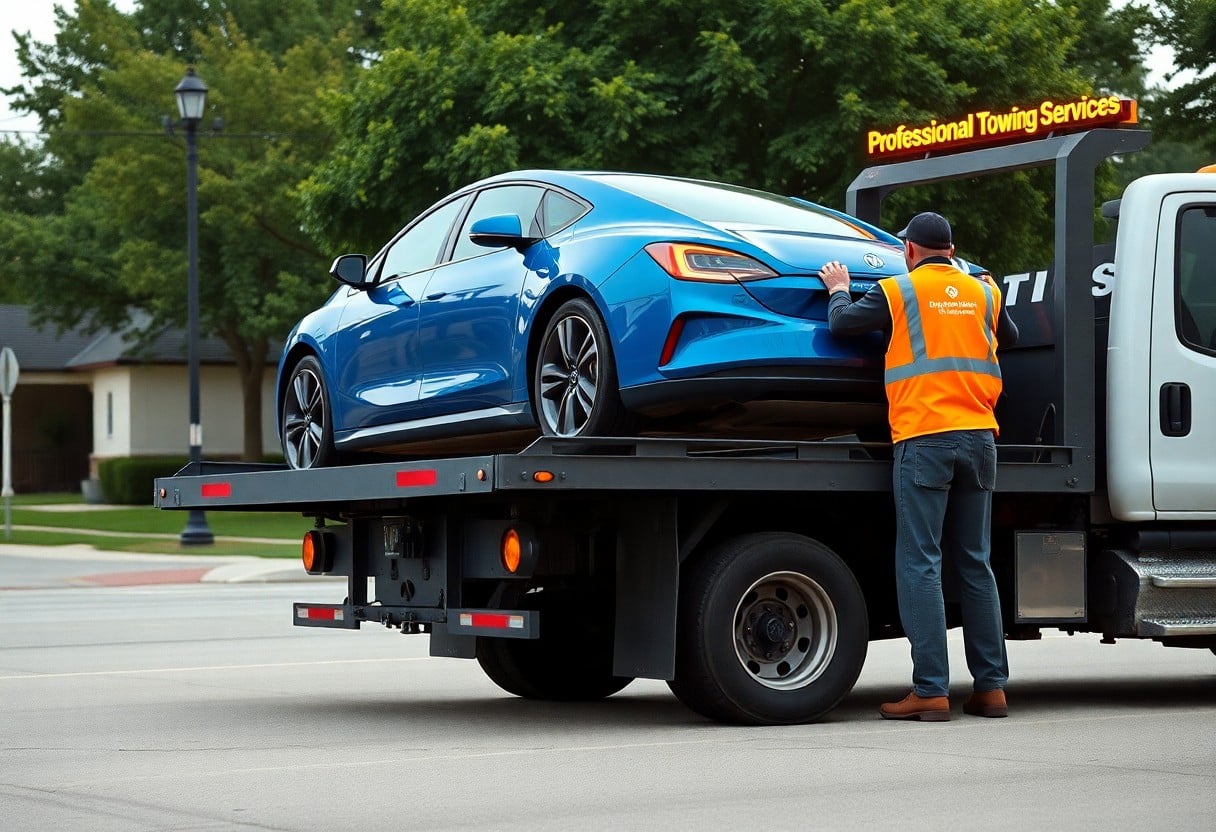
Many times you may need to tow your electric vehicle in Allen; you should ensure the tow operator uses flatbed equipment or the manufacturer’s recommended procedures, disconnects the high-voltage system where required, and follows local regulations to avoid battery damage and voiding warranties. Verify the tow company’s EV experience, confirm insurance and permits, and keep emergency contact and vehicle manuals handy so you can make informed decisions quickly and reduce risk during transport.
Key Takeaways:
- Always choose a flatbed tow truck in Allen – it keeps all wheels off the ground and minimizes risk to the drivetrain and battery.
- Confirm the vehicle’s tow instructions (owner’s manual or manufacturer’s hotline); some EVs prohibit wheel‑lift or dolly towing and require a specific transport mode.
- Tell the tow operator the vehicle is electric and verify they will disable drive engagement, set tow/transport mode, and avoid using lifting points near the battery pack.
- Make sure the 12‑volt system is charged so power steering, regenerative braking, and electronic parking brakes can be released; if the 12V is dead, rely on a flatbed and follow manufacturer guidance.
- Hire a tow company experienced with EVs in Allen and confirm they have the right equipment, training, and insurance before loading the vehicle.
Understanding Electric Vehicle Towing
Knowing how towing methods interact with your EV’s battery, drive units, and electronics helps you avoid expensive damage; for example, flatbeds keep all wheels off the ground and are recommended by most manufacturers, while towing with driven wheels on the pavement can spin motors or trigger fault codes. You should verify owner‑manual guidance and ask the tow operator about vehicle-specific transport modes before moving your car.
Types of Towing Methods
Your options typically include flatbed, wheel‑lift, tow dolly, and a drive‑away service; each affects your EV differently depending on whether driven wheels remain on the ground, whether steering is locked, and whether the vehicle’s high‑voltage systems are isolated during transport.
- Flatbed: all wheels off, safest for most EVs.
- Wheel‑lift: rear or front wheels suspended, can stress drivetrain if driven wheels stay engaged.
- Tow dolly: two wheels on ground, risky for AWD or single‑reduction motors.
- Drive‑away: requires a licensed driver and active systems-rarely recommended for EVs.
- Assume that you must confirm whether to place the car in transport/neutral mode before any wheels contact the road.
| Flatbed | Best for all EVs; prevents wheel spin and drivetrain stress. |
| Wheel‑lift | Acceptable only if non‑driven wheels are lifted and OEM allows this method. |
| Tow dolly | Only for rear‑ or front‑wheel non‑driven configurations and short distances. |
| Flat tow (all wheels on ground) | Generally not advised for EVs unless explicitly permitted in the owner’s manual. |
| Transporter/carrier | Commercial car hauler; good for multiple vehicles, still safest to secure EVs on a flatbed deck. |
Risks Associated with Towing EVs
Towing can damage electric motors, gearboxes, or battery thermal systems if driven wheels turn without proper disengagement; software faults, regen malfunctions, or high‑voltage harness strain may occur, and some manufacturers state improper towing may void warranty, so you should always follow OEM procedures and use flatbeds where possible.
In practical terms, spinning an EV’s motor during a tow can generate unexpected currents and heat-cases exist where improper wheel‑on towing triggered error codes that required dealer diagnostics and repairs costing thousands. You should ask the tow operator about placing the vehicle in “transport” or “neutral” mode, disconnecting 12V systems if recommended, and avoiding long, towed distances with wheels rolling, since heat and abrasion can degrade seals, bearings, and battery cooling components.

Local Regulations in Allen
City rules in Allen mirror Texas statutes and local ordinances, so you should verify the tow company holds a valid city permit, posts its rates, and carries proof of insurance before authorizing a tow. Private-property tows require authorization from the property owner, and vehicles are typically processed for release within 24-72 hours; you should request an itemized invoice and photographic condition report when reclaiming your EV.
Towing Laws Specific to Electric Vehicles
Manufacturers such as Tesla, Nissan, and Chevrolet recommend flatbed transport or specific neutral/transport modes, so you should always tell the dispatcher your EV make and model to ensure OEM procedures-like battery isolation or wheel-off handling-are followed. Allen’s enforcement centers on correct equipment and trained crews to prevent battery, drivetrain, or electronics damage that can lead to costly repairs or warranty disputes.
Compliance and Permits
Before you approve a tow, ask the operator for the Allen permit number, proof of liability coverage (commonly $300,000 or more), and a written rate schedule; non-consensual tows must align with posted signage and chain-of-custody rules. You should insist on a written receipt and photos of vehicle condition to protect against damage claims or billing disputes.
If your EV includes high-voltage components or advanced driver-assistance systems, some carriers require OEM-trained technicians or documented battery-disconnect procedures, so you should confirm operator training and EV-specific equipment like insulated straps and isolation mats. For long-distance or commercial transports you may need a city or county transport permit; contact Allen Police or the city towing coordinator to verify permits, record permit numbers, and submit photographic evidence when reporting unauthorized or noncompliant towers.
Best Practices for Towing an Electric Vehicle
Prioritize flatbed towing and communicate your EV’s make, model, and battery status to the operator before loading; most manufacturers and roadside services in Allen recommend wheels-off transport to avoid drivetrain and inverter damage. You should also verify the truck’s rated capacity exceeds your EV’s curb weight (many EVs weigh 3,000-5,500 lb) and confirm the operator follows OEM guidance for disengaging parking brakes and activating tow mode.
Preparing Your EV for Towing
Before the tow, you should remove charging cables and personal items, set the vehicle to “neutral” or manufacturer-specified tow mode, and disable any auto-hold or electronic parking brake per the owner’s manual; for example, Tesla and Nissan provide in-app or in-car procedures. Also photograph the vehicle and note battery state-of-charge and tire condition so you can report pre-tow status if needed.
Choosing the Right Tow Equipment
Pick a flatbed with a winch and adjustable ramps so your EV is loaded at a low angle to protect low ground clearance; avoid wheel-lift or dolly towing that leaves drive wheels on the road. Confirm the truck’s bed length and gross vehicle weight rating (GVWR) can handle your EV plus any accessories-if your EV weighs 4,500 lb, you want capacity above that number.
Go further by asking the operator for specifics: the flatbed’s maximum load (in pounds), the winch type (electric with soft-start is gentler on low-clearance vehicles), and the strap method-use soft loop straps on tie-down points rather than hooks on suspension components. If your EV is all-wheel drive, insist all wheels be off the ground; for rear- or front-drive models, check OEM guidance about whether a dolly is permissible. Document the tow operator’s answers and, when possible, choose a service that lists EV experience or OEM certifications.
Recommendations from Manufacturers
Manufacturers frequently specify acceptable towing methods for each EV model, and you should consult the owner’s manual or online service bulletins before any tow. Many OEMs list flatbed towing as the preferred option and warn against wheel‑lift or dolly towing that leaves driven wheels on the ground. Confirm whether the battery must be in neutral, whether the 12‑volt system needs isolation, and whether a dealer inspection is required after a tow to avoid damage or diagnostic complications.
Manufacturer Guidelines
You should follow the procedures published by the OEM-Tesla, BMW, Ford and GM each provide model‑specific towing instructions in owner manuals or service portals. Those documents often specify allowed towing methods, required gear or drive‑unit disconnection, and any speed or distance limits for flat towing; some manuals explicitly forbid wheel‑lift towing. Provide your tow operator with the exact model year and VIN so they apply the correct instructions for your vehicle.
Warranty Considerations
If improper towing causes damage, your warranty claim for the battery pack, power electronics or drivetrain can be denied. You should keep documentation of the towing method, operator credentials and all receipts, and notify the manufacturer or dealer promptly. Many manufacturers require a post‑tow inspection before authorizing warranty repairs, so timely disclosure and proof of approved towing methods can protect your coverage.
After the tow, photograph the vehicle and the tow setup, obtain the tow company’s name, license and invoice, and contact your manufacturer’s roadside assistance or dealer to log the event and request authorization if needed. Using an authorized tow provider and retaining written proof of approved procedures-plus the VIN and service records-reduces disputes and strengthens any warranty claim for battery or drivetrain work resulting from the incident.
Finding Professional Towing Services in Allen
You should prioritize providers that list EV experience, flatbed capacity, and 24/7 response on their websites; many Allen companies advertise arrival in 20-30 minutes and flatbeds rated 7,000-10,000 lb. Verify insurance, ask about OEM-approved procedures, and cross-check online reviews and Better Business Bureau ratings before you call-this reduces the chance of improper handling that can add repair bills or void warranties.
Local Tow Service Providers
When you check local firms, confirm they operate tilt-flatbeds, carry low-angle beds for low-clearance EVs, and quote base fees (often $75-$150) plus per-mile rates ($2-$5). Ask for fleet photos, proof of insurance, and recent customer examples of EV tows; if a dispatcher can name the flatbed model and its load rating, you’re speaking to a prepared operator rather than a general hauler.
EV-Specific Towing Experts
Choose specialists who advertise OEM or ASE training, use flatbed-only policies for most EVs, and carry insulated wheel adapters and hydraulic winches; some Allen operators list Tesla-approved flatbed service and documented EV procedures on intake calls. Expect slightly higher fees-often a $25-$75 surcharge-because technicians follow high-voltage safety steps and use dedicated equipment.
On-scene, you’ll want the tech to place the vehicle in manufacturer tow-mode or neutral per the manual, disconnect the 12V auxiliary battery if required, secure the car with non-conductive straps, and avoid applying a wheel-lift to a drivetrain-unfriendly model. Ask whether the crew logs the VIN and battery state, communicates with OEM roadside assistance if needed, and carries PPE for high-voltage work before you approve the tow.
Common Myths about Towing Electric Vehicles
You’ll encounter myths that EVs can’t be towed, will always catch fire, or require special hazmat crews; in reality most issues come from improper methods. Many manufacturers (Tesla, Nissan, Chevrolet, Ford) explicitly recommend flatbed towing or neutral/transport mode, and most modern EVs use 400V battery systems (some up to 800V) that trained tow operators isolate before handling. Prioritize technicians who use flatbeds, wheel chocks, and follow maker guidance to avoid drivetrain or electrical damage.
Debunking Misconceptions
People often assume any tow truck will do, but you should insist on EV-capable crews; wheel-lift towing can damage transaxles or motors on some models. Fires during towing are extremely uncommon and usually tied to crash-damaged packs, not routine transport. Ask the provider for examples of EV jobs they’ve done and confirmation they’ll use a flatbed or the manufacturer-approved procedure for your specific model.
Facts vs. Fiction
Fact: flatbeds are the safest method for most EVs; fiction: all EVs can be rolled on their wheels without consequence. Motor or inverter damage can occur if wheels spin without proper neutralization, and different models require distinct procedures-single-motor, dual-motor, and inboard vs. hub-motor designs behave differently. You should follow the owner manual and the tow company’s EV protocol.
For more detail, verify your vehicle’s towing instructions (owner manual, manufacturer website) and relay them to the dispatcher; for example, Tesla and many OEMs specify flatbed transport or engage “transport mode.” Confirm the tow crew will immobilize wheels, disconnect 12V systems if instructed, and avoid charging or jump-start attempts unless OEM guidance permits it-these steps limit risk to the 400-800V battery and drivetrain during transit.
To wrap up
So you can have your electric vehicle towed safely in Allen if you choose a flatbed or a tow provider experienced with EVs, follow your manufacturer’s tow instructions, secure the battery and parking systems, and confirm the operator knows how to disable drive modes. You’ll get the safest outcome by using qualified roadside assistance or dealer-recommended services rather than ad-hoc towing methods.
FAQ
Q: What towing methods are safest for electric vehicles in Allen?
A: The safest method is a flatbed tow truck that carries the entire vehicle off the ground. Flatbeds eliminate wheel rotation and drivetrain stress, reducing risk to the motor, transmission (if present) and battery pack. Wheel-lift or dolly towing can be acceptable only for specific models and configurations (for example, when non-drive wheels are on the ground); always verify the vehicle manual first and prefer flatbed when in doubt.
Q: Can my electric vehicle be towed on all four wheels or with a tow dolly?
A: That depends on the vehicle. Many EVs should not be towed with drive wheels turning because regenerative systems and sealed drivetrains can be damaged. Some models allow short, low-speed towing with the vehicle in neutral or in a dedicated tow mode, but long-distance towing with wheels on the road is generally discouraged. Check the owner’s manual or contact the manufacturer’s roadside assistance before using a dolly or four-wheel tow.
Q: How should I prepare my electric vehicle for towing in Allen?
A: Tell the tow operator the vehicle is an EV and confirm they will use a flatbed. Before towing: remove the charging cable and secure the charging port, put the car into the manufacturer-specified towing or neutral mode if available, disengage the parking brake, and follow any battery isolation steps listed in the owner’s manual. Keep the key or fob accessible so the operator can shift modes if needed. If you’re unsure of steps, ask the tow company to contact the vehicle manufacturer or call the manufacturer’s roadside assistance for guidance.
Q: Will towing my EV incorrectly cause battery or warranty problems?
A: Improper towing can cause mechanical or electrical damage (to motors, drivetrain components, or battery systems) and could affect warranty coverage if the vehicle isn’t towed according to manufacturer instructions. Using a flatbed and an experienced EV tow operator minimizes risk. Keep records of the tow provider’s procedures and any manufacturer guidance to support warranty claims if needed.
Q: How do I find qualified towing services in Allen and what should I ask them?
A: Look for tow companies that advertise flatbed service and EV experience. Ask whether they have flatbeds large enough for your vehicle, if their operators are trained on EV-specific handling, and whether they know how to place your model in tow mode. Request proof of insurance, an estimate for local and long-distance tows, and availability for after-hours service. If possible, call the vehicle manufacturer’s roadside assistance first and ask for recommended tow partners in the Allen area.