Over peak traffic hours you can expect towing response in Allen to range typically from 15 to 45 minutes; your exact wait depends on traffic density, dispatcher prioritization, tow truck availability, and proximity to major arteries. To minimize delay, you should provide precise location, vehicle details, and any hazards so dispatch can route the nearest available unit to your aid promptly.

Key Takeaways:
- Typical arrival during Allen peak traffic: 30-60 minutes; can reach 60-90 minutes during major congestion or incidents.
- Primary delays come from distance and congestion on major routes (e.g., US‑75, Sam Rayburn Tollway) and time of day.
- Service type matters: light-duty tows are usually faster; flatbeds or heavy‑recovery take longer due to limited availability.
- Using local companies or roadside-assistance memberships (AAA/insurer) generally speeds response versus large dispatch brokers.
- Providing exact location, landmarks, vehicle details, and a contact number when calling shortens dispatch and arrival time.
Understanding Peak Traffic Hours
In Allen, peak periods typically fall on weekdays from about 7:00-9:00 AM and 4:00-6:30 PM, when commuter volume on US‑75, SH‑121 and Stacy Road spikes. You’ll notice average speeds on those corridors drop from roughly 45-55 mph to 20-30 mph, and event nights (high‑school games, mall sales) can create sudden surges that directly increase tow response times.
Definition of Peak Traffic
Peak traffic means vehicle demand exceeds roadway capacity, producing stop‑and‑go flow and higher incident rates. For you that translates into trip times 20-50% longer than off‑peak, increased lane changes, and more frequent secondary collisions that further slow routes tow operators rely on.
Effects of Peak Traffic on Towing Services
You should expect longer arrival times because tow trucks must navigate congested corridors, limited shoulders, and blocked access points; what might be a 20-25 minute off‑peak pickup commonly becomes 30-60 minutes in peak periods and can stretch to 60-90 minutes during major incidents.
Dispatch teams mitigate delays by pre‑staging vehicles at known hotspots (the I‑75/SH‑121 interchange, Stacy Road corridors) and prioritizing accidents over lockouts; when operators pre‑position within 2-5 miles of a busy stretch you can see response times improve by roughly 10-20 minutes compared with reactive routing from distant yards.
Average Response Times for Towing Services
Expect typical towing arrival times during Allen peak traffic to range from about 30-60 minutes for light‑duty calls; major incidents or highway collisions can push that to 60-90 minutes. You’ll see faster responses (20-40 minutes) in neighborhoods within five miles of a yard, while calls on US‑75 or near SH‑121 during rush often exceed an hour. Dispatch load and active incidents shift these averages.
Factors Influencing Response Times
Several variables determine how quickly a tow reaches your vehicle: distance from the operator, current dispatch load, lane closures, weather, and whether you need light‑ or heavy‑duty equipment. You’ll notice GPS routing and local staging shave minutes, but crashes and major roadwork can multiply delays. After on‑scene paperwork and vehicle recovery, expect an additional 10-20 minutes before full clearance.
- Distance from tow yard
- Dispatch queue and priority
- Road access and active lane closures
- Type of equipment required (light vs heavy)
- Weather and visibility
Comparison of Response Times in Different Areas
In Allen, you’ll get the quickest service in suburban residential zones-typically 20-40 minutes-because crews are staged nearby; downtown commercial districts average 30-50 minutes due to access and parking constraints. Highway incidents and major interchanges routinely show the slowest responses, 45-90 minutes, especially when multiple vehicles or blocking lanes are involved. Your location relative to tow yards and incident severity largely dictates where you fall in these ranges.
Response times by area
| Area | Typical Peak Response |
|---|---|
| Suburban residential | 20-40 minutes |
| Downtown commercial | 30-50 minutes |
| Major arterials / interchanges | 45-90 minutes |
| Industrial / heavy‑vehicle zones | 40-80 minutes |
Digging deeper, you’ll see proximity to major corridors and yard locations has measurable impact: being within two miles of a tow yard typically cuts arrival by ~10-15 minutes; heavy‑duty recoveries add 20-40 minutes. Local operator logs show weekday evening highway calls spike roughly 20-30% between 5:00-6:30 PM, shifting medians toward the upper ranges.
Delays by area
| Area | Primary Delay Factors |
|---|---|
| Suburban residential | Distance, yard availability |
| Downtown commercial | Access, parking, permits |
| Highways / interchanges | Incident severity, lane closures |
| Industrial / truck routes | Heavy‑duty equipment needs, loading |
The Role of Location in Response Time
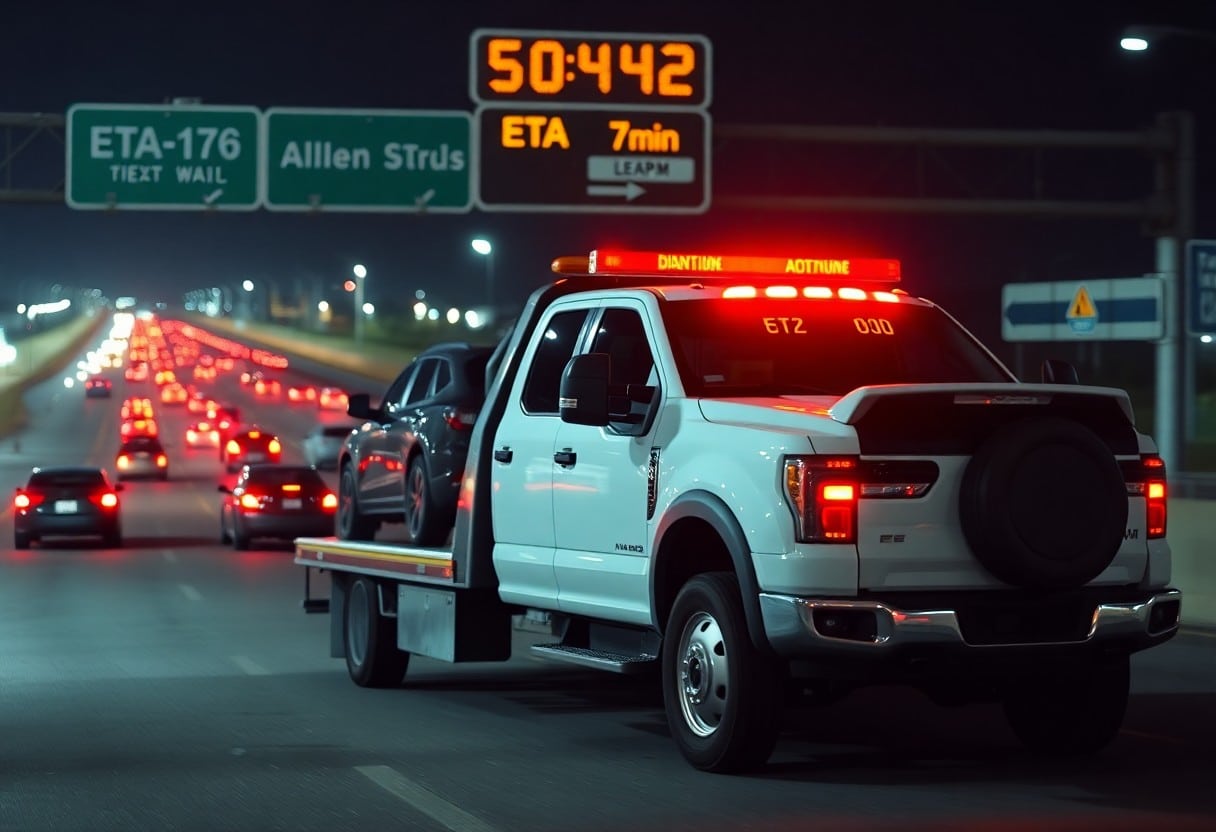
Where you are in Allen directly changes how quickly a tow can reach you; being within 3-5 miles of a provider often yields 15-30 minute arrivals in moderate traffic, while 5-15 miles typically produces 30-60 minutes during peak. Areas adjacent to US‑75 and the Sam Rayburn Tollway see faster service because many companies stage nearby, whereas rural or edge-of-city spots can push waits past an hour if units must travel from farther depots.
Distance from Towing Service Providers
If you’re parked within a 5‑mile radius of a centrally based operator, your tow often arrives 10-25 minutes quicker than someone 10-15 miles away. Companies that stage roving units along high‑use corridors cut response times by roughly 10-20 minutes; conversely, requests falling outside a provider’s primary service zone may be routed to subcontractors, adding 20-40 minutes as trucks reposition.
Traffic Patterns and Their Impact
When you’re stuck during weekday peaks (about 7:00-9:00 AM and 4:00-6:30 PM), directional congestion on US‑75 and SH‑121 can halve average speeds and convert a 30‑minute response into 60-90 minutes, especially with lane restrictions or incident clearances. Night construction on Stacy Road and accident hotspots near major exits are common sources of added delay you should anticipate.
For more detail, you can track live conditions: if US‑75 average speeds dip to 20-30 mph, expect tow units to detour via surface streets or use service roads, which can add 10-30 minutes but avoid total gridlock. Calling the dispatch for an ETA tied to live traffic and asking whether a company has roving units nearby gives you the best chance of an accurate arrival window.
Communication with Towing Services
When you call a towing service in Allen, the initial exchange decides how efficiently they can get to you; many dispatch centers log call-to-dispatch times under 7 minutes and reputable operators provide live GPS tracking within 5-10 minutes of assignment. You should state your vehicle type, exact lane, cross street or mile marker, and any access restrictions so dispatch assigns the right unit and avoids reroutes that can extend your wait from 30-60 to 60-90 minutes during major congestion.
Providing Accurate Location Details
Give precise info: GPS coordinates or a screenshot, nearest cross street, lane number, and a landmark or business name plus which entrance you’re nearest. If your car is blocking traffic or on a shoulder, say so-this often changes response priority. Providing these details up front can cut misdirection and typically reduces arrival variance by 10-20 minutes because crews avoid blind searches and unnecessary detours.
Importance of Timely Updates
Timely updates let you track ETA changes and let dispatch react to new conditions; expect texts or a live-tracking link that refreshes every 5-10 minutes with many providers. If you clear a lane, move the vehicle, or find hidden damage, tell dispatch immediately so they can reroute or send different equipment, preventing repeated arrival attempts and extra fees.
More info: ask the company which channel they prefer-call, SMS, or app-and their typical update cadence. Local Allen operators often call at dispatch, then send an SMS with an ETA and tracking link, and update when traffic shifts or when a truck is within 10-15 minutes. Keep your phone on and respond promptly; documented messages also help resolve disputes over arrival time or charges.
Safety Considerations during Peak Hours
During peak traffic you should prioritize visible signals and precise location details to speed response; on US‑75 and SH121 where speeds often exceed 60 mph, staying inside with your seatbelt fastened and hazards on reduces risk. Call the tow and provide mile marker, nearest cross street and vehicle color; if you must exit, move at least 20 feet from traffic and behind a barrier when possible. Expect typical peak response of 30-60 minutes in Allen unless incidents create larger delays.
Tips for Drivers in Need of Towing
If you stall on a busy Allen roadway follow these steps:
- Turn on hazards and, if safe, set cones or warning triangles 10-15 ft behind your vehicle
- Call a local tow, give exact cross street or mile marker, vehicle make, model and color
- Stay inside with seatbelt fastened or move 20+ ft from traffic to a protected area
Any sign of smoke or fuel leak means you should exit the area entirely and call 911 immediately.
Precautions Taken by Towing Services
Tow crews in Allen typically deploy LED arrow boards, cones and flares within 2-5 minutes of arrival to establish a safe work zone; many companies run two-person crews on major corridors to manage traffic control and vehicle recovery simultaneously. They select flatbeds for heavily damaged vehicles and wheel‑lift trucks for quick, light-duty moves, using winches rated 10,000-20,000 lb depending on vehicle class and condition.
When the crew gets to you you’ll see technicians in ANSI Class 3 hi‑vis vests, gloves and steel‑toe boots trained in Texas DOT roadside safety protocols; teams use GPS with real‑time traffic apps to reroute and often carry written damage‑claim forms and insurance details so you can document any incidents during loading. These procedures commonly reduce secondary risks and speed up safe clearance on congested corridors.
Local Towing Service Options in Allen
Within Allen you can choose between national networks (AAA, insurer-affiliated services) and smaller local operators; national dispatch often draws trucks from 15-40 miles away while local firms typically run 3-8 tow trucks and commonly quote 30-60 minutes during peak hours, extending to 60-90 minutes during major congestion. You should compare quoted arrival times, equipment (flatbed vs. wrecker), and flat-rate vs. per-mile pricing-local light-duty flatbed jobs often fall in the $75-$150 range inside the city, while long-distance tows cost more.
Reviews and Recommendations
When vetting providers, prioritize recent mentions of punctuality and safety: aim for services with 4.0+ average ratings on Google or Yelp and multiple reviews referencing arrival times during rush hour. You can also ask neighbors on Nextdoor or call Allen PD non-emergency to confirm preferred vendors after accidents; check the BBB for unresolved complaints and favor companies that publish real-time ETA tracking or provide dispatcher confirmation numbers.
Contact Information for Quick Access
Save at least three contacts-one national provider (AAA or insurer hotline), one local tow, and one emergency roadside app (HONK or similar)-and put them on your phone’s favorites or speed-dial; keep a printed card in your glovebox with company names, policy/membership IDs, and payment options. Use apps to request service and share live location via Google Maps so dispatchers can pinpoint you faster.
Also create a contact template you can copy into messages: company name, direct dispatch number, typical ETA, accepted payment methods, your vehicle make/model, license plate, membership/policy ID, and a recent photo of your location; storing the tow company’s logo or vehicle description in the contact helps you verify the arriving truck and avoid delays or scams.
Summing up
To wrap up, in Allen during peak traffic you can generally expect a towing service to arrive within 20-45 minutes, though times vary based on congestion, distance, company workload, vehicle type, and call priority; using a local 24/7 operator, giving your exact location, and confirming an ETA can shorten waits, while major accidents or rush-hour bottlenecks may push arrival toward an hour. Plan accordingly and keep clear communication with your dispatcher to help get you back on the road sooner.
FAQ
Q: How long does a towing service typically take to arrive in Allen during peak traffic hours?
A: Arrival times usually range from 20 to 45 minutes within central Allen during peak hours; suburbs or highways can extend waits to 45-90 minutes depending on congestion, incident volume, and truck availability.
Q: What main factors affect towing arrival times during rush hour in Allen?
A: Key factors include current traffic congestion and road incidents, distance from the nearest available tow truck, type of tow required (flatbed versus light-duty), access constraints (gated lots or parking structures), weather conditions, and the company’s active call volume and prioritization policies.
Q: Can I get faster towing service during peak times, and what speeds up the process?
A: Yes-faster service is possible by calling a local company directly, using a paid emergency or priority service, contacting your roadside-assistance membership provider, or using apps with real-time dispatch. Give exact GPS coordinates, clear landmarks, a phone reachable at the scene, and note vehicle size or special needs to help dispatch send the appropriate truck quickly.
Q: What should I do while waiting to minimize additional delays and keep everyone safe?
A: Move the vehicle out of travel lanes if safe, activate hazard lights, set out warning triangles if available, keep the car accessible and unlocked for the driver if instructed, have registration and ID ready, and stay on the line or available by phone to receive ETA updates or clarifying questions.
Q: How do towing companies calculate ETAs and how reliable are those estimates during peak traffic?
A: Dispatchers estimate ETAs using the location of their nearest available truck, live traffic data, expected route, and estimated on-scene handling time. Estimates are best-effort and can change quickly due to accidents, emergency calls, or sudden road closures; reputable companies provide live updates when situations change.